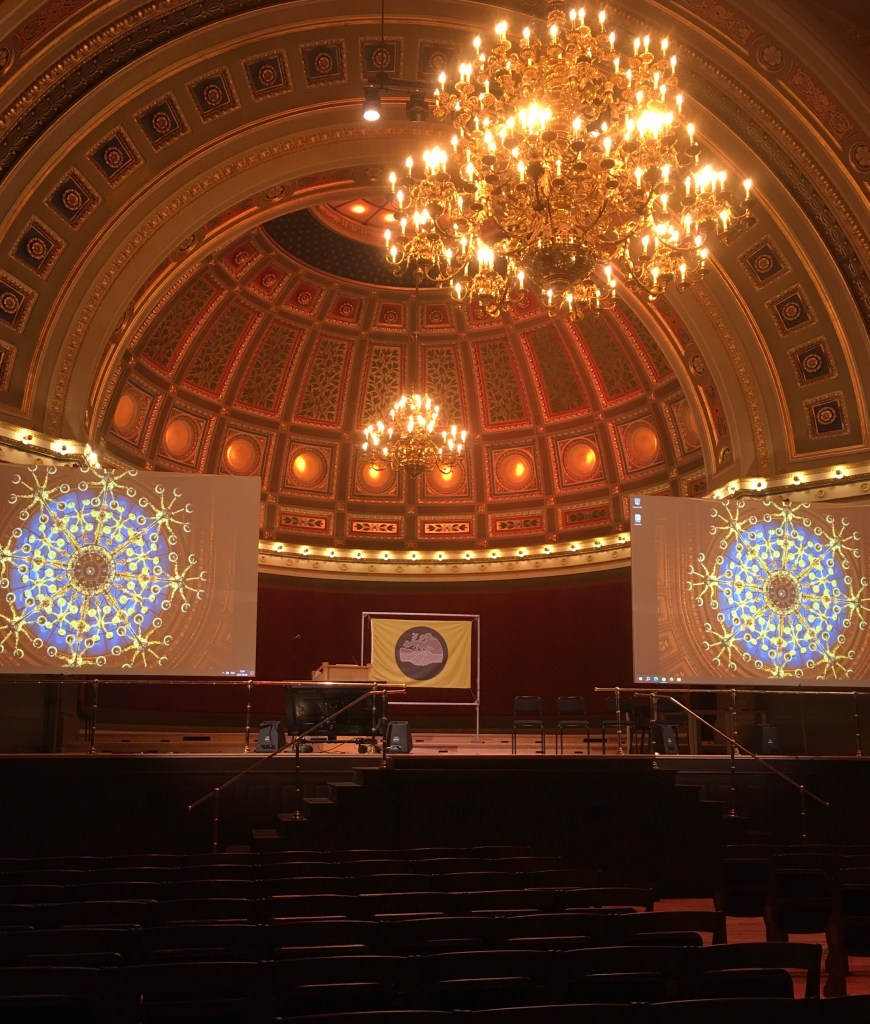
University Hall, Uppsala, June 8-11

Friday 10:00 HOPEPUNK AS A SPECULATIVE SUBGENRE in Sal X (scaffolding inside)
Niels Dalgaard, Andrew Dana Hudson (Mod), Ian McDonald, Jane Mondrup, Örjan Westin
Alexandra Rowland 2017 essay
Question of the -punk suffix—not attached to technological means (does it matter?)
What degree of things going well is needed to be considered hopepunk (is it too early to make this distinction in terms of a movement v a useful mental note when a genre label becomes trendy—the question, Is Handmaid’s Tale hopepunk because it is framed as a historical document of a better world? versus Is it helpful for readers, to hypothetically market Handmaid’s Tale as hopepunk?)
Should this be called a genre? (Perhaps an approach? But ‘approaches’ are not currently marketable as genre is and with the interest of getting this out there—future of multiple-sub-genreing like metal until it’s basically trope tags or marketing ease of singular label)
A question of scale. Hope and doing good and community is local but evil scales up – power attracts power, rich get richer
Learned hope and rational utopian
Psych in what is considered ‘literary’—interior and personal versus interpersonal connection
Friday 11:00 MAGIC IN THE MODERN WORLD in Sal X
Stefan Ekman, Rhuddem Gwelin (Mod), Eva Holmquist, Åsa Lundström, Amanda Magnevil
(had to leave early)
Move to active TBR pile:
Rivers of London
Craft Sequence
Friday 13:00 ALTERNATE HISTORY in Aula
Jean Bürlesk, Jukka Halme (Mod), Rasmus Häggblom, Cheryl Morgan, Martha Wells
Point of divergence
– magical divergence
All historical fiction is alternate history—what is your approach to history? Moving beyond ‘great man moves the world’ narrative will help you choose your point(s) of divergence
New element changes the course of history / new element doesn’t change much, after all
Time travel distinguished from alternate history? Sci fi future alternate history (not just counting older stuff dated to ‘the year is 2010’ etc)
(For All Mankind IS a good time sorry nobody will talk about it mod)
Small scale alt history—Karen Joy Fowler’s We Are All Completely Beside Ourselves
Friday 14:00 DATING GODS AND MONSTERS in Sal IV
Stine Björkelid, Jean Bürlesk, Sissel Hanström (Mod), Elena Pavlova
no notes (panel went into such depth with dynamics and was so funny that I just listened)
Friday 15:00 AI AND IDENTITY in Aula
Niels Dalgaard, Eva Holmquist, Andrew Dana Hudson, Mikko Rauhala (Mod), Martha Wells
no notes (was tired)
Skipped the evening and missed out on GoH Interview: Francesco Verso or The Wild Magic of Diana Lynne Jones, First Contact Then and Now or Glass as a Material Through the Ages, Speculative Poetry and Where to Find It or What We Talk About When We Talk About Writing (3 hours) (definitely too tired)
Saturday 10:00 TRENDING IN NORDICS in Sal IX
Boel Bermann, Patrik Centerwall, Marija Fischer Odén, Hildur Knútsdóttir, Anna Sellin (M)
*some substitutions, panel included Amanda Setterwall
Genre marketing
– Horror + crime/noir v speculative
– Iceland v into literary, trojan horses SFF
– Swedish horror does not have to disguise itself like SFF
– Anecdotally, Swedish fantasy for adults not thought of as fantasy?
Cozy horror drama over on Twitter
Natural horror received differently in different countries: What do you do if you are lost in the forest in Iceland? You stand up.
Icelandic ghost stories
Folklore is not a trend because it is always, but what have we not picked up from regional traditions?
Trends
– away from hard sf
– literary writing sci fi ‘and trying to get away with it’ (panelists did not answer/understand q)
– dystopian/apocalyptic—>climate fiction ’IPCC scenarios are the best apocalyptic fiction’ (but depending on the scenario)—>possibly more hopeful stories
– in Finland, YA-driven hopeful/punk and queer authors
HK’s The Night Guest translation out in January
Saturday 12:00 WHERE’S THE HANDRAIL? WORK ENVIRONMENT SAFETY AND UNIONIZING IN SFF in Sal IX
Anna Jakobson Lund (Mod), Moa Råhlander, Ian Sales, Edmund Schluessel
Bias/blindness of middle class authors—ignore the people who allow you to be middle class
Interstellar empires and their access to labor and what those lives look like—and not undermining with narrative of a particularly singular hero
To find class in SFF you first have to see class
The Metropolis Problem—abrupt pivot to head and heart resolution
Utopia doesn’t mean there is no story—but can be handy to do a utopian society with a neighbor (Culture series)
Human nature means that some people will be happy under the worst conditions and unhappy under the best (Tea Monk Robot f off to the woods drive)
(Somebody Wati please)
Saturday 15:00 HOLDING UP A DISTORTED MIRROR TO THE WORLD in Aula
Francesco Verso, Eva Holmquist, Amanda Magnevelli, Hans Persson (Mod), Merja Polvinen
The thoughts that you have while reading a work are just as essential to the individual ideas in the work—because you cannot really engage with the entirety of a thing and hold it in your mind at once
Can sci fi be written without using our world? Ask, can the sci fi be read without it?
Multilingual – language influences the types of stories you tell-can let go of expectations and restraints? Particularly with gender
What we’re doing now—global sci fi, marginalized sci fi, solarpunk
Saturday 16:00 LET THE SWEDISH HORROR IN in Sal IV
Boel Bermann, Gunilla Jonsson (Mod), Michael Petersen, Markus Sköld
*some substitutions, panel included Amanda Setterwall
“Something lurks inside our empty husks”
Historically gothic horror, themes of Christianity
The Conference (movie)
Works that are not Swedish and find their inspiration in Swedish culture for horror versus what Swedish people go to horror for—not Midsommar, also German writing groups under Swedish pseudonyms writing horror about Sweden (and possibly romance?) for Germans, interrogating this stereotype of egalitarians all holding hands and skipping together
Some elements explored in horror for Swedish
– perception of being a borderland slash fear of identity being dissolved into larger Western homogenization
– 20th century town decay (as discussed with AKR in context of Norbotten plus green industries), “broken/rundown people in broken/rundown places” but also small town setting + crime fiction rather than horror (v similar with US crime + horror, but is not a commonality we connect with more and do not import more of?)
(Triangle?) Socially realistic/based in reality fiction—popularity of crime which folds in horror tropes—horror from other people
Horror’s flexibility in not needing to be speculative (compare to subgenre question of hopepunk which also does not need to be SFF can be more like climate fiction, intra and interpersonal conflict—with horror, the uncertainty of speculative elements is part of the fun?)

 Mercy Calder
Leave a comment