On the day of the Conception, a boy and his two classmates Chiaki and Isamu visit their sick teacher, Ms. Takao, at the hospital. Chiaki intends to use the visit to ask for career advice. If confronted, she attempts to justify her selfishness by saying that the boys should be thinking about their futures, too. Then Hikawa and Ms. Takao bring about the Conception, and those futures are destroyed along with the world.
(For a quick intro to SMT3, and to read the rest of the series, click here.)
Chiaki is astoundingly awful, so let’s be clear: this is what makes her a great character. Chiaki is a weak human at the mercy of an unforgiving world. She is given the opportunity to change the rules of this unforgiving world, and nonetheless adopts those rules as her own. She brutally slaughters the people who wish to make a place without suffering. And in the end, even if she wins, she dies, because she cannot live up to the ideology she shaped from the world.
While searching for Chiaki in the aftermath of the Conception, the Demi-fiend runs into a childlike Kodama.
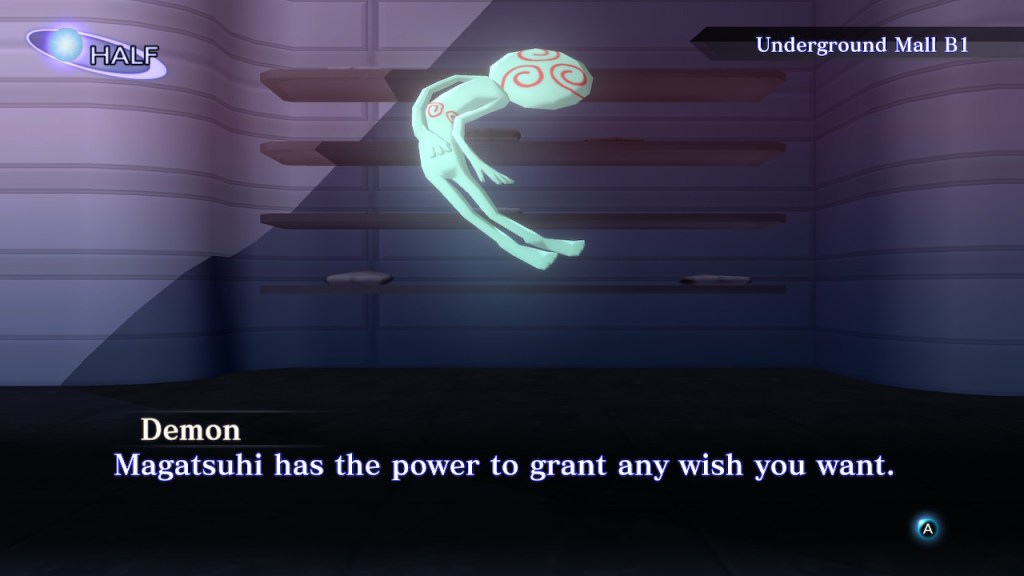
This Kodama suggests Magatsuhi is a many-branching path, where power is just one of the wishes Magatsuhi can grant. As he encounters others who seek Magatsuhi, he finds that few see Magatsuhi this way. It seems to be a single road, in which power leads to the fulfillment of wishes. The road shapes those who walk it, and their desired destination.
That destination, for most, is the new world, shaped by a Reason: an idea for how society should be.
The three named Reasons focus on making use of power in the Vortex World to determine how others may use power in the future. Hikawa’s Shijima eliminates the desire for power, Isamu’s Musubi shields individuals from others’ power, and Chiaki’s Yosuga rewards power with power.
There are many kinds of power—overt or subtle, self-harming or uplifting, hoarded or shared. In the Vortex World, the word power only means physical or magical prowess, the ability to assert one’s will over others. Domination, might. Magatsuhi, the source of power, is an extracted resource. It’s pulled from the vast network that spans the Vortex World, from reservoirs in the earth. It’s also pulled from individuals: demons, disembodied souls, and Manikins, mud shaped by Magatsuhi into human form and sentience.
Magatsuhi was made from the dead of the previous world, and will fuel the creation of the next. In the transitory Vortex World, power designates autonomy and worth, and the lack of it serves as an excuse for exploitation and subjugation—circular logic that flows as freely as Magatsuhi.
By narrowing the definition of power, Nocturne asks, as few games ask so competently, What if power was everything?
What if, for your own survival, you used the power you were granted, even as you learned what everyone else seems to already know—that power and suffering are intertwined? What if your friends chose power over you? What if they only held onto your friendship because they saw you as a tool for gaining power themselves?
Would you still treasure what power could not give you? Or would you let the pursuit of power shape your desires, and the world?
PRESS TURN COMBAT
A high school student survives the apocalypse and enters the Vortex World as a human—weak, but with the potential to shape the world to come. This weakness, and this potential, are robbed from him by the childlike Lucifer. Lucifer forces demonic power upon him, with no better explanation than for Lucifer’s own amusement. The student becomes the half-human, half-demon Demi-fiend. Before he truly understands what has been taken from him, he learns to use this power to survive against the demons that wish to devour him for his Magatsuhi.
Many role-playing games use a turn-based combat mechanic, in which the player and the game-controlled opponent politely take turns trying to kill each other with various attacks. In Nocturne, this is also how the Demi-fiend finds demon allies and how he gets stronger so he can fight g/‘God’(s).
Nocturne is infamous for its potentially punishing difficulty. Its version of turn-based combat, the Press Turn system, can be fun one moment, and an infuriating slog the next. Whether the game deserves its reputation, the combat system forces the player to engage with power on the Vortex World’s terms.

Press Turn rewards a savvy player who exploits weaknesses by granting them additional opportunities to attack, and takes away those turns when the enemy does the same. The player is encouraged to remember their losses and learn from their mistakes.
The player feels justified when they take advantage of a weakness and earn those extra turns. Depending on how the enemy earns theirs, the player’s reaction ranges from respect to feeling cheated. Whoever has more allies has the advantage too—more people equals more turns. Press Turn works in the favor of those who gang up on weaker enemies and works against whoever is out there trying to rough it alone.
In Nocturne, there is no dissonance between gameplay and storytelling. At its worst, Press Turn makes you feel like you’re in an unfair world and you just want to go home, you never asked for any of this, everyone is out to use you and drain you and leave you for dead. At its best, it feels like a power trip. And there’s always something stronger down the road. That’s the Demi-fiend’s new life.
CREATION FAVORS THE POWERFUL
The half-human, half-demon Demi-fiend has the power to defend himself and thrive in the Vortex World, but is barred from conceiving a Reason that will shape the creation of the new world. He can, however, use his power to support a Reason, and in time, most who wish to conceive a Reason will call upon him for help.
Creation favors the powerful. The Tower of Kagutsuchi is “a stairway to creation for the strong… And a tower of certain death for the weak.”
Kagutsuchi is the source of light for the Dyson Sphere-shaped Vortex World. Kagutsuchi is also the entity that will make a new world for humanity from a Reason. There are a few prerequisites. A Reason must gather a following and collect enough Magutsuhi as a sacrifice to attract the attention of a strong god that will sponsor the act of creation. In addition, only humans are permitted to conceive a Reason.
How does Kagutsuchi weigh each ideology’s suitability for the coming world and determine which Reason is worthy? It doesn’t. It hands out tokens to the leader of each Reason, tells them that one Reason needs to hold all the tokens, and lets them fight each other to the death. Sure, it’s possible that the Reasons could talk and work something out and possibly unite, but considering that Kagutsuchi afterward fights a Reason’s representative to prove that Reason’s worth, Kagutsuchi seems to prefer trial by combat. The Reason with the strongest followers, then, has the advantage.
THE MANTRA AT A CROSSROADS
If the Vortex World exists primarily for the sake of creation, and creation favors the powerful, then it would make sense that the powerful demonic inhabitants of the Vortex World would strive for creation the second Kagutsuchi says ‘go’. But that’s not necessarily true.
In smashed-up Ikebukuro, the Demi-fiend finds that the group of demons called the Mantra are at a philosophical crossroads. Relative newcomer to the Mantra and second-in-command Thor has talked to their leader, Gozu-Tennoh, about having higher aspirations. A soul in Ikebukuro says that thanks to Thor, “the Mantra finally look like an actual organization and not just a group of barbarians.” (Maybe Thor was the one to come up with Kabukicho Prison?)
Most Mantra, including Gozu-Tennoh, are content to carve out their kingdom of chaos in the Vortex World. However, the Assembly of Nihilo strives for the creation of a new world of stillness, which would be an end to that kingdom.

Gozu-Tennoh launches an attack against the Assembly of Nihilo’s headquarters, believing that by defeating Nihilo, he will save the world for all future demons. Combatants critique each other in a way that echoes the player’s growing understanding of Press Turn battle: the brawny Mantra trash Nihilo for being a bunch of nerds and brainy Nihilo make snide remarks about superior strategy over brute force. Nihilo retaliates with their Nightmare System, an instrument of Magatsuhi extraction that sucks the power out of Gozu-Tennoh and the rest of Mantra headquarters (but curiously leaves humans and Manikins unharmed).
When the Demi-fiend goes to see Gozu-Tennoh afterward, the Mantra’s leader claims his doom is at hand because he lacked a higher goal. This may be true; it is certainly true that the Mantra lost due to inferior strategy, because the Assembly of Nihilo developed a more effective method of Magatsuhi extraction, and because Hikawa is as vindictive as he is melodramatic.
THE REASON OF YOSUGA
Chiaki witnesses the fall of the Mantra in Ikebukuro. She last spoke to the Demi-fiend at a nightclub in Shibuya, where she told him she wanted to gather the other survivors. “Giving up on them means giving in to despair,” she confided before she set off on her own.
Her search to stave off despair warps into the Reason of Yosuga, built off Mantra ideology. During her solitary trek across the desert, she had a lot of time to think. “Not only about what I should be doing in this world… But why the world had to end up this way.” She has a new goal: to be the one to create the new world.
Then she heard about how the Demi-fiend won the Mantra’s respect through the (sham) trial by combat. The rumor-current of the Vortex World must have transformed a laughable satire of previous world justice systems into an inspiring story of the triumph of true strength. Thanks to the harsh new world, and thanks to the Demi-fiend, Chiaki has her Reason.

In the vision that accompanies Chiaki’s explanation of her Reason, she poses as a teacher at the head of a classroom, or a ruler on an improvised throne.
Was that why Chiaki wanted career advice from Ms. Takao? She wanted to become a teacher? The students in her vision are duplicates of the same male silhouette. If she did want to teach, was it most important to her that she gained a role of authority that would shape young lives, rather than the specifics of individuals? All three Reason visions show only the Reason-bearer as an individual, and Shijima and Musubi are more explicit in how little they care for the rest.
As Chiaki continues, the vision of the classroom dissolves, leaving only her. If teaching was her previous ambition, that path is useless to her in her new surroundings. If not, then perhaps she sees herself in that guiding, shaping role that Ms. Takao previously occupied. Forward-thinking Chiaki’s left the small microcosm of high school behind. The arena of authority is no longer the classroom, but the open possibility of all to come.
Chiaki insists, “I was chosen to be here. That’s what I believe, and that’s how I’m going to carry myself. I know that if I bear the pain, I can open up a world of limitless potential.”
She pins her conviction on her survival of the Conception. Her fortitude got her to Ikebukuro, but it was being the friend of Ms. Takao’s favorite student that saved her from the Conception—if Ms. Takao is worried about Isamu or Chiaki in the Vortex World, she doesn’t share this concern with the Demi-fiend.
Ms. Takao seems to only care for the Demi-fiend’s wellbeing. Was it fate that Chiaki’s selfish tendencies landed her in the one place that would allow her to survive the Conception? Was she chosen? Or is that just what she needs to believe?
“The previous world was full of waste,” Chiaki says, “clogging up our thoughts and choking out any real progress. From an overabundance of things to an excess of people… We ran out of useful things to make and meaningful things to do.”
This speaks to a life of sheltered privilege, and a harsh ending to that safety. According to Hikawa, the previous world was trapped in an endless cycle of war. War that didn’t seem to touch Tokyo. Ms. Takao may have thought the previous world was losing its power, but it generated a great deal of Magatsuhi from the strong negative emotions of its inhabitants. Perhaps there were still meaningful things to be done, though none of those actions would have been on the scale of the Conception. That choice was unknown and out of reach for Chiaki until after the fact, but still, it might be hard for her to look back and see meaningful accomplishments and helpful interventions as anything but futile efforts.
Kagutsuchi maybe encouraged Chiaki to rationalize and categorize when it told her she “could choose.” Waste, progress, useful, meaningful (and later, virtue and worth). It’s one way to make sense of a series of frightening events out of your control.
“An excess of people” is the claim that gives pause. It could be a naive parroting of an eco-authoritarian overpopulation scare point, or an early indication that Yosuga’s “paradise ruled by the strong and the worthy” was always going to turn into, as a Power later puts it, a world “where the weak will die.”
She credits the Vortex World with the inspiration for her Reason when she announces that she’s “finally decided to play by the rules of this world.” Strength dominates the Vortex World, from the flow of Magatsuhi to Press Turn combat (and at this point, it’s hard to imagine Chiaki has decent stats). It fits that she states her Reason in the stronghold of the Mantra. Chiaki’s “paradise ruled by the strong and the worthy”—as well as the connection between worthy ideals and success—is echoed shortly after by Thor:
“The Assembly of Nihilo had a higher goal than just ruling over Tokyo. We, on the other hand, did nothing more than enforce a reign of terror… That is the reason we lost. I will go on a quest to realize my dream of a world where the strong thrive.”
Chiaki doesn’t have a different definition of power or strength than Thor. She expects the Demi-fiend to understand her because he won that gossiped-about trial by combat. Her ideology converges with a faction in decline, but still, Chiaki is too weak to fill the power vacuum. She believes she needs to gather Magatsuhi on her own before anyone will take her ideology seriously.
The Mantra, unorganized as they were, had a dedicated Magatsuhi-harvesting facility at Kabukicho Prison. Nihilo’s Nightmare System extracts Magatsuhi on a Vortex World-wide scale. How would weak Chiaki, with no talent for manipulating the Amala Network or accessing any other sources, get any power of her own? How can she compete?
Rumor spreads of an item called the Yahiro no Himorogi which contains a large amount of Magatsuhi and has the power to control gods. Three people go after this item: the Demi-fiend (possibly on Ms. Takao’s behalf), Chiaki, and a Manikin named Sakahagi.
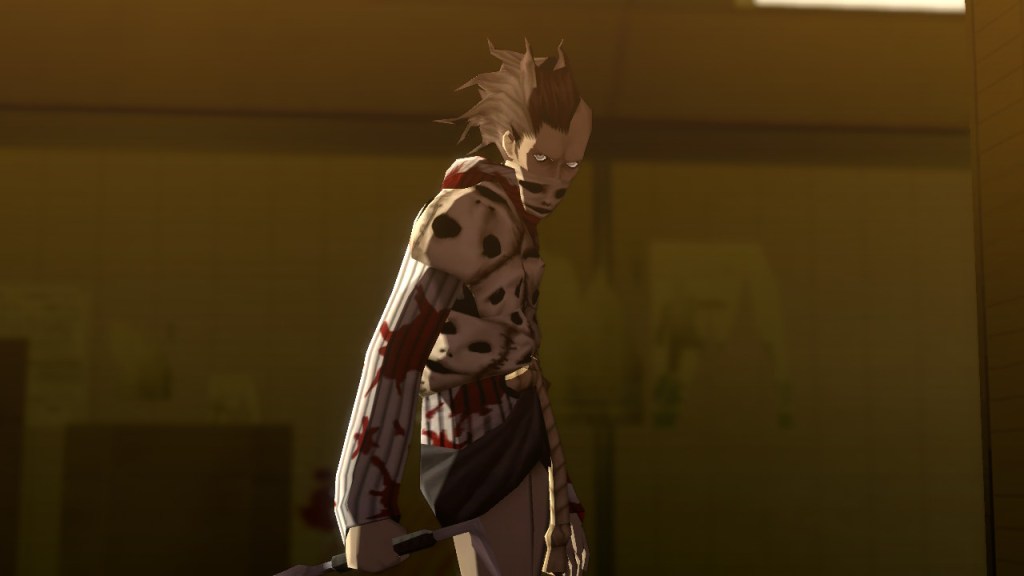
The Manikin prophet Futomimi warns the Demi-fiend about Sakahagi: “A traitor to our cause, having committed unforgivable atrocities.” Sakahagi preys on fellow Manikins for their Magatsuhi and wears their skinned faces, taking enough enjoyment in splattering their blood to make a Mantra demon blush.
In the nebulous time before the fall of the Mantra, Sakahagi was one of the Manikins united by Futomimi’s leadership. Sakahagi suffered under the Mantra and lost faith in a guiding figure, which echoes Isamu’s experience. His desperate search for power ties him to Chiaki. And like Chiaki, his drive to prove that he’s powerful can’t be separated from his drive to prove that he’s not powerless.
The Demi-fiend follows the bloody trail Sakahagi leaves. He doesn’t find Chiaki, only hears after from Sakahagi that he inflicted some kind of slasher film ‘painful lesson’ on her when she attempted to challenge him for the Yahiro no Himorogi. The Demi-fiend finds her after in Mantra’s headquarters, angry at her own powerlessness, nursing the stump of her right arm amid Gozu-Tennoh’s shattered remains.
Chiaki now seems to suspect that her striving and suffering might not guarantee a reward. She is a human, and has the attention of Kagutsuchi, and suffering has a distinct purpose in this world. Magatsuhi comes from suffering. Suffering is power. Suffering will create the new world—other people’s suffering. Not hers, not on her own. She’s not willing to rethink her Reason, but it’s becoming clear to her that she can’t live up to her own ideals. She fears that she will not get to participate in creation. She doesn’t challenge the barriers to creation, because she thinks of herself as ‘chosen.’
Besides, Chiaki is once again in the right place at the right time. Before Gozu-Tennoh succumbed to Nihilo’s attack, he declared that “In time, one worthy of my power will come. It is then that I shall return!”
His spirit hears Chiaki’s rage at her unfulfilled dream—a kind of rage he shares. Chiaki wonders aloud if Gozu-Tennoh’s spirit called for her, though it’s unclear if Gozu-Tennoh’s spirit even knows who she is. Whatever is left of Chiaki Tachibana outside her special status as a human and her belief in Yosuga is completely irrelevant. She is the only person capable of bringing about his dream. He grants her the remains of his power.
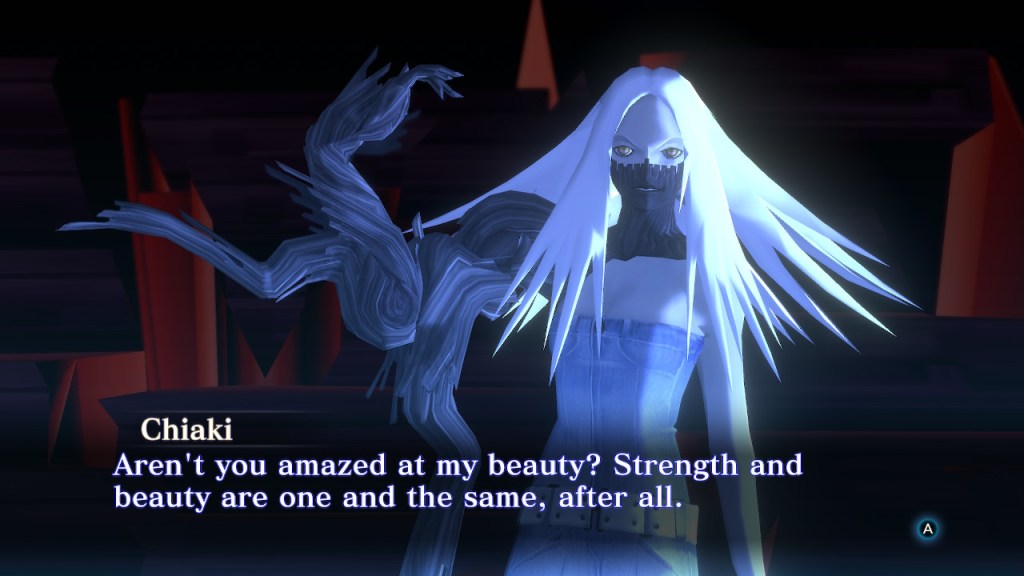
It doesn’t matter if the Demi-fiend thinks Chiaki is beautiful, only that her supporters do. Just like her clothes in the previous world, her demonic appearance shows she belongs to a certain class. She likely thinks she’s being rewarded for her trials. But just like the Demi-fiend, she’s been picked out by a higher power for their own motives.
This achievement of beauty and power seems to be what makes the difference. Chiaki gains the support of the Divines—Biblical angels—though they never cared for Gozu-Tennoh or her before. Do they agree with Chiaki’s Yosuga and, like Gozu-Tennoh, give Chiaki their power and help her bring that vision into being? Or do they influence Chiaki to bring Yosuga closer to their own principles?
Chiaki never experiences Mantra at its height. She is never brutalized for her weakness as a human or drained of Magatsuhi, like Isamu. Perhaps if she had, she would have understood the ramifications of her nascent Reason before she invested so much of her own struggle into it. Even so, maybe she understands that, for all the opportunity that being a human affords her in the Vortex World, she could just as easily be cast as low as the Manikins herself. By the time she loses her arm to Sakahagi, who lives by the same rule she does, she’s too committed to Yosuga to do anything but rationalize the violence as a trial to overcome.
The Demi-fiend, however, did see Ikebukuro in its prime. The fountains and side halls are still piled with the decomposing bodies of Manikins. He knows many Mantra demons owe their strength not to their own effort, but to gifts from Gozu-Tennoh. He remembers the Yomotsu-Ikusa who declared with darkly comical glee: “The weak must obey the strong—those Manikins are a fine example! We’ll enslave them for all eternity! Enjoy the law of nature, bitches!”
The tenets of all Reasons are debated throughout the Vortex World. In the middle of combat negotiations, a demon might ask the Demi-fiend a question such as,
“IF A MIGRATING BIRD INJURES A WING, WINTER WILL TAKE ITS LIFE. NATURE IS A DEVICE THAT ROOTS OUT THE WEAK. THEN THERE IS NOTHING LEFT FOR THE WEAK, BUT TO DIE?”
There is no winter in the Vortex World. Nature, in the previous world, was a big place. It held leeches that care for their community’s young in nurseries. Reefs where fish don’t break the peace, so that smaller fish will clean their bodies of parasites. Dry mountain slopes where a wet spring means a good year for rabbits, followed by a good year for foxes, then a bad year for foxes. ‘Survival of the fittest’ doesn’t reflect the nuanced forces that determine who thrives, or for how long. But this is a world in which people’s beliefs can become codified into reality, even if all this debate is in the service of creating a new human society, which is what picks up the slack after natural selection has clocked out.
The Mantra tradition of saying the oppression part out loud evolves as Mantra headquarters becomes the Citadel of Yosuga. A Dominion says, “Only an elect few ought to inherit the earth. The trivial masses deserve death. Cruel this may be, but is it not also rightful?” (If the Demi-fiend agrees, then the Dominion gives him 1000 Macca and tells him not to stray from his belief, reminding him, “Only the chosen ones should live.” Gozu-Tennoh was more generous with his bribes.)
A Principality, disgusted at their surroundings, says, “This place is a filth-ridden vermin’s nest”, which could refer to the Mantra demons, who are nonetheless welcome in Yosuga. The Power spying on Isamu at the Amala Temple says “[t]here are plenty of vermin remaining who have yet to receive our judgment” just before Yosuga attacks the Manikins at Mifunashiro.
Gozu-Tennoh made no remark on his opinion of Manikins, but plainly he saw them as disposable. It’s unclear how much of Gozu-Tennoh’s prejudices exist in Chiaki, but the Divines despise the Manikins, too. There are only glimpses of an explanation to be found: these Biblical Divines are so distanced from the process of creation that they must ally themselves with a human’s Reason if they want to be included. Most Manikins gaze upward in regular contemplation of Kagutsuchi, the highest representative of the Great Will in the Vortex World. One Divine scorns Kagutsuchi, referring to it as a “goddamn arrogant disco ball”.
In general, though, there’s little reward in seeking out the root of such hatred. The Vortex World rewards the self-centered and judgmental elements of Chiaki’s personality, and in a very real way, the Vortex World only exists so that the humans within it can develop their ideologies. Those who once had a closer connection to creation, like these Divines, could assure Chiaki that any resource that exists within the Vortex World is rightfully hers for the taking. Manikins don’t exist outside the Vortex World. They’re Magatsuhi reservoirs. Magatsuhi was made from the dead of the previous world, and serves to fuel the creation of the next. Chiaki needs no further justification to massacre them.
FIGHTING (FOR) YOSUGA
Ever since the Manikins returned to Asakusa, they have quietly been gathering their own Magatsuhi, even though they are forbidden from creation.

The angelic demons of Yosuga find a world of such ‘blind altruism’ unforgivable.
If the Demi-fiend encourages Chiaki when she first shares her Reason, then she adds, “I might ask you to help me out.” During the massacre at Mifunashiro, Chiaki remembers the Demi-fiend’s earlier support, and at last, asks for the Demi-fiend’s help. The only person sort-of standing between Chiaki and the Manikins’ Magatsuhi is a wounded Futomimi.
The Demi-fiend doesn’t have to help her. If he doesn’t support Chiaki’s Reason of Yosuga, she is downright bewildered. His vast demonic power is proof of Yosuga’s ideals. He partly inspired her ideology in the first place. Rejected, Chiaki will declare their friendship ended, but she will never stop marveling at how he belongs with Yosuga.
Chiaki’s not going to ask Futomimi why he insists on helping his fellow Manikins, even though he’s stronger on his own than any of the Divines who attack Mifunashiro. He’s not proof of Yosuga’s ideals. He’s an ‘arrogant mud puppet.’
Futomimi’s moveset resembles an okay Demi-fiend physical build—one that would work with the support of strong allies. Alone, in Press Turn combat, Futomimi is at a disadvantage. He can’t shrug off anything the Demi-fiend or demon allies might do to weaken him, and he can’t heal himself. It’s weird he doesn’t know the two recovery moves Meditation and Prayer, considering all the time he spends meditating and praying. With those he could be a serious threat on his own.
Unlike Chiaki or Sakahagi, Futomimi has never aspired to stand alone. Futomimi is strong alone, and that doesn’t help his cause. Sure, he can kill the Demi-fiend in a single lucky blow. (It wouldn’t save the Manikins if he did). By this point, though, the Demi-fiend has enough power that luck is on his side. Luck makes power, and power makes luck.
The fight against Futomimi is the opposite of the early fight against Matador. The infamous Matador fight is where the player must prove they understand Press Turn battle. If they don’t safeguard their own weaknesses or use the right spells to counter Matador’s evasiveness, they’re not getting far. Don’t underestimate Futomimi—that was Chiaki’s error with Sakahagi—but there’s no way the Demi-fiend would have gotten this far if he didn’t understand how to take advantage of the power granted by Lucifer, and there’s no real way he can lose to someone without those advantages.
With Futomimi dead at her feet, Chiaki remarks that the Manikins’ Magatsuhi was maybe all meant for her in the first place. Her sense of entitlement and worth is secure, now that she has survived long enough to look back in retrospect and see direction in chance. She summons her god of creation and re-introduces herself as “Baal Avatar, paragon of virtue and might, bringer of glory.” And because she is the paragon of virtue and might, everything she does is virtuous and mighty.
When Chiaki first spoke of Yosuga, she based her ideal world on concepts of what is and isn’t ‘useful’, ‘meaningful’, ‘superfluous’. Her intent remained abstract because Chiaki hadn’t acted on her nascent beliefs. Gozu-Tennoh tells the Demi-fiend that “insatiable greed is a demon’s virtue.” This seems to have the ring of a Mantra tenet, so perhaps the word ‘virtue’ has been circulating in Chiaki’s mind for some time. Now, Yosuga’s ‘virtue’ is forever defined by her ruthlessness against the people she reduces to ‘mud dolls.’
If the Demi-fiend kills Futomimi, Chiaki-as-Baal Avatar recognizes him as a ‘paladin’ of Yosuga. But even with the support of her god, Chiaki is still the young woman who wanted power and who cried in fury when she thought she couldn’t have it. Now that she has power, she’s afraid she can’t keep it. She gives in to this fear, and in doing so, makes it a reality. In the Tower of Kagutsuchi, on the verge of creation, Chiaki challenges the Demi-fiend for the throne of Yosuga and loses. Chiaki dies without resentment because the Demi-fiend’s victory proves Yosuga right. Would she have died with grace if she’d met her end at the hands of someone who didn’t fit her ideals?

SO WHAT IF CHIAKI’S A HYPOCRITE?
Many are quick to point out that, like everyone who strives to create a Reason, Chiaki is a hypocrite. She’s weak, needs the help of others to steal from the people she calls weak, and insists “the world has no more room for anything superfluous.” Who are the superfluous people in a kingdom of the strong, if they need to rob from the weak to gain their strength?
Hypocrisy only happens to undermine the causes of unconceived Reasons. Yuko cannot come up with a Reason herself after critiquing others for their inaction, seeking direction from a goddess who embraces the ambiguity of freedom. Futomimi, for all his talk about working together and sharing in responsibility, all but certainly keeps the specifics of his more dire prophecies to himself, hiding the truth from the other Manikins. Hikawa wages war to create the still world of Shijima, and Isamu’s followers band together to create Musubi, a world where everybody lives on their own. So what if Chiaki’s too weak to live up to her own ideals?

When Chiaki was weak and struggled and dreamed of power, it wasn’t a sin—because she’s human. Her greatest power is that she’s human. She’s the only one who can make Yosuga’s ideals a reality. And unlike Shijima and Musubi, the Vortex World offered a vision of how the Kingdom of Yosuga might function, in Mantra.
Power gains power by granting it to those who will work to further entrench its authority. Power remains in power by taking from those who might threaten it, and rewarding its peers. Gozu-Tennoh sat petrified in place at the top of Mantra HQ. He didn’t fight his own battles. He freely gave power (likely taken from Manikins) to the Demi-fiend, in recognition of the power the Demi-fiend already had. Gozu-Tennoh also freely gave that power to comparatively weak Oni who supported his ideology. Once power establishes itself in this way, power is only changed by a great upset—in the case of Gozu-Tennoh, the counterattack from Hikawa and the Assembly of Nihilo, which allowed the Manikins to escape, and robbed any dwindling Mantra forces of their base of power.
This is what Kagutsuchi means when it calls Yosuga “a kingdom which rejoices in conflict”—and possibly why Kagutsuchi sounds a little unenthused to bring Yosuga into being.
Yosuga (as an organization that exists in the Vortex World) mimics the power dynamics and prejudices that go into creation. This is likely because Chiaki drew so much inspiration from the Vortex World. Her survival of the Conception and her early days in the Vortex World also more than likely shaped her views of the failings of the previous world.
A different scenario, in which the Demi-fiend instead brings Ms. Takao’s undefined ideology of Freedom to Kagutsuchi, reveals that Kagutsuchi is invested in the overall ‘progress’ of the cycle of creation and destruction, even though Kagutsuchi accepts whichever Reason fights its way to the top of the tower. Yosuga doesn’t come off as a particularly unique concept for a new world (it’s certainly no Musubi). But that might be the bias of the previous world—which Hikawa brought to an end because he perceived it to be trapped in an endless cycle of war and greed.
Chiaki’s Yosuga still placed her in the position where someone more powerful than her might ruin her future. Her dream was to become that powerful person and make others’ futures yield to her own. She intended to create a new world that had none of the faults she saw in the last one. But in Yosuga, she developed a Reason that might do no better than recreate the problems of the world that came before.
 Mercy Calder
Leave a comment